

Раиса Арефьева

«Правосудие»
Painting
07/09/09
|
Liked: 15
|
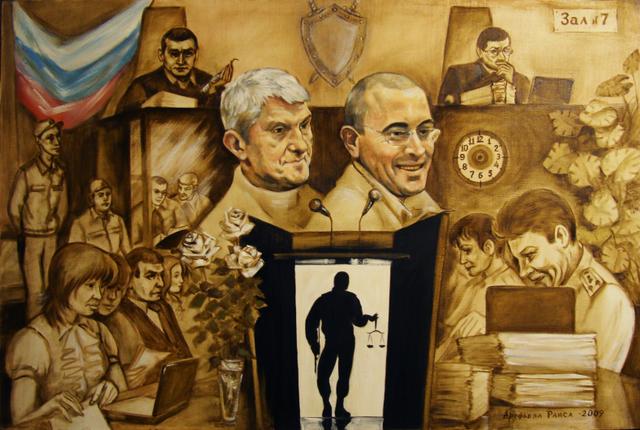
| In my series of paintings Khodorkovsky. The Court Is in Session I tried to express my vision of the court system’s present state in this country, as well as to show passions and emotions of the trial participants. In these paintings, the power structures’ wish is expressed symbolically, to demonstrate their power by different means, which is dictated by their political and economic interests, to force everyone to live and work by their own rules that are the rules of bullies, and not the law’s rule. Moreover, of course, these paintings show my reflections on what ultimately influences the trial, and the court’s final verdict. What holds more power, law and justice or power and money? What and who will take an upper hand? I wanted to show that if the world is a stage, and the people are the actors, then there are personalities among them, and there are puppets. There was the routine of reading sessions and court examinations, conceived only to undermine the spirit of those against whom ungrounded accusations in absurd activities are leveled. Puppets realize their lives’ goals based on their lives’ philosophies. In the painting Justice the composition’s movement is defined by the tedious flow of the process itself, clockwise from the lower left corner where the counsels for the defense sit. They have white roses on their desk that symbolize justice and rightness. There are the guards behind the defense’s back, and one of them is tired with the trial, but the other one draws the spectator’s gaze towards the courtroom procedure. The dock metamorphoses into the bench with the judge sitting there with his face impassively ironic (as if saying, gotcha!); he has taken his glasses off, and fixes the defendants in the composition’s center with his stare. Behind Platon Lebedev and Mikhail Khodorkovsky’s backs, there is the symbol of justice, the shield with crossed swords aimed at the defendants. Then, the same judge covers his mouth with his hand, which is interpreted in psychology as a gesture of hiding a lie; he looks at the notebook monitor, listening to the prosecutor’s monotonous speech. Under the judge, there is a clock without hands, the symbol of vacant passing of time, and the process’ infinity, as well as the target. Under the clock there is the prosecution, zealous in their wish to complete the mission (which is testified to by heaps of papers on their desk), and clearly understanding what is going on here (which is shown by the male prosecutor’s grin, and the female prosecutor’s impassivity). A burdock-like plant behind their backs is a further emphasis on the monotony, and intentional confusion of the proceedings. Below, in the painting’s center there is a rostrum, with the microphones turned away from the defendants, thus emphasizing that no one is interested in hearing them out. Under the rostrum, there is the symbol of “fair” justice, the male Themis with scales in one hand, and firearms in the other. I have fulfilled a request from one LiveJournal user, and this figure is now depicted separately, with some alterations in its character. The paintings Insomnia, and M. Khodorkovsky—The Passage of Time reflect the defendants’ inner feelings and emotions. They are proposed to be placed to the left and to the right of the Justice centerpiece respectively. Against all odds, the main characters hold on with dignity, do not lose their spirits, and are mentally in control of their environment. —Raisa Arefyeva |
