
About the Contest

Exhibition "Drawing the Court - 2" in support of the "6 May Prisoners" at International Memorial
The "Drawing the Court - 2" exhibition showcases courtroom sketches of socially significant trials that took place in recent years in Russia, Ukraine and Belarus. We focused on political trials.
The exhibition is comprised of two sections, which are provisionally entitled "agitational" and "historical". Inside the Great Hall, you will see poster prints in support of those currently being prosecuted.
The "historical" section is a compilation of original sketches from trials whose defendants have already been released. We are displaying sketches from high-profile and lesser-known trials without giving preference to cases that have received media coverage.
While most people do not read court reports if the defendants' names are not immediately recognizable, they might look at sketches. Court sketches are not simply a substitute for photography; the artist conveys their relationship to the events and assessment of the situation. Quite frequently, court sketches harmoniously incorporate records: renderings of participants in the situation, fragments of the court transcript and author commentary.
Just recently, а guilty verdict for the "6 May Prisoners" was handed down. But the political trials have not ended; the case against Udaltsov and Razvozzhayev is under way and hearings for the remaining defendants in the "Bolotnoye case" will soon begin.
They all need our attention and support.
An electronic archive with hundreds of sketches drawn by artists over six years of work on the project is available on risuemsud.ru.
Participants in the exhibition:
Ekaterina Belyavskaya
Ilmira Bolotyan
Radik Vildanov
Viktor Volodarskiy
Svetlana Gofman
Anna Zvyagintseva
Viktor Korb
Andrey Kortovich
Lyubov' Krutenko
Tamara Krutenko
Olga Lavrenteva
Viktoria Lomasko
Marina Naprushkina
Iya Ozerova
Alexandr Tot
Vlad Tupikin
Anna Shefer
Curators: Victoria Lomasko, Zlata Ponirovskaya
Producer: Natalya Dashevskaya
Partners:
Radio Svoboda, Colta, Bolshoi Gorod, 6 May Committee
The exhibition will be open on Fridays and Saturdays from 14-28 March 2014. Hours of admission are 11:00- 18:00.
The opening will take place on 14 March at 19:00 at: Sadovaya ul. Karetniy Ryad d5/10, International Memorial.
More info about project
The genre of courtroom sketches first emerged in France, in mid 19th century, and quickly spread to other countries, including Russia. The history of Russian law would not be complete without drawings by Pavel Pyasetsky and Vladimir Makovsky made at the “March 1” Group trial, sketches from the Beilis Trial, the Kukryniksy group’s graphic series “Accusation” created after the Nuremberg Trial. There are moments when a single drawing made in a courtroom can tell us more about prosecutors, lawyers, judges and other parties of a process better than scores of photographs.
The trials our project focus had already become a factor of the Russian contemporary history and it still attracts public and media attention. The trials has gone beyond a mere social phenomenon, and has become a fact of Russian contemporary culture, being covered not only by journalists, but also artists, poets, and novelists.
Recently, some Russian cultural figures have become defendants in court proceedings. Public court cases now frequently compel creative people to turn to an activity somehow alien to them, when they have to address public through print or electronic media, or write open letters. The Drawing the Court contest and the subsequent art show are the civilized and accessible means to understand the contemporary Russian court’s heterotopia, as well as to present this understanding to viewers. The trials thus serves as a reference point, being one of the significant phenomena of the Russian contemporary history, and another step in the eternal interaction of man and law.
Contest
The contest aims at allowing the participating artists to express different political, aesthetic and moral positions, but its principal goal is to touch upon the living reality of legal proceedings in a courtroom.
Works submitted to the Drawing the Court contest web site or other contest Internet sites, are eligible to enter the contest. The contest participation means that the participants have read and agreed to the contest rules. The works can be submitted from July 10 through September 8, 2009, inclusive.
The contestants should visit the public trial of Mikhail Khodorkovsky and Platon Lebedev, taking place on workdays, in the Khamovnichesky court (please see the attendance instruction).
In order to register with the Drawing the Court web site, and submit works to the contest, every contestant should enter the special code issued when entering the courtroom.
Upon the attendance, the competitors are to submit their work (works) in one of the below categories. An electronic copy of the work is to be published on the contest web site or other contest Internet sites.<[p>
Awards
The four categories winners as well as the winner of the user voting will be awarded with the Contest Grand Prix, a trip to New York, following the time-honored Russian tradition to send artists abroad to study and practice their art.
Categories
A panel of competent judges, including leading artistic, media and business figures, will then select winners in each of the 4 categories:
— Painting (works without any genre limitations, made in oil, watercolor, ink, acrylic, pastel, tempera, on canvas, cardboard, paper, and other support bases);
— Courtroom sketch (drawings and sketches, made in the courtroom in any technique, and on any support base);
— Caricature (comic and satirical works, made in any technique and on any support base, excluding canvas. Computer graphics is eligible for entering the contest);
— Illustration / comic strip (works made in any technique, that illustrate real or imagined turns of the court proceedings, in the format of an illustration or comic strip).
One work will receive a special award provided by the project’s title partner OpenSpace.Ru Internet portal OpenSpace Choice. This award will be given regardless of the contest category.
A separate award will be given to the work favored by Internet users, as based on the user voting.
The Drawing the Court contest’s final art show will open on September 15, 2009
Jury
Olga Lopukhova — the candidate of history, art curator, and art manager. The member of the International Association of Art Critics, the executive director for the Qui vive? Moscow International Biennale for Young Art, the executive producer of the Innovation Contemporary Visual Arts Contest, the M. Prokhorov Foundation expert.
Sergey Lukashevsky — the executive director of the Andrey Sakharov Memorial Museum and Community Center.
Victor Melamed — an illustrator since 1997, British Higher School of Art and Design (BHSAD) tutor and lecturer, Tsekh Illustrators’ Association founder, the Dom Art Gallery curator, columnist.
Maria Stepanova — the OpenSpace.ru web portal editor-in-chief, essayist, poet, critic, and journalist. She is the author of six books, and the “Znamya” magazine prize winner (1993), Boris Pasternak (2005), Andrey Bely (2005), awards winner.
Xixyc — the ComMission Festival organizer, the Dead Fish Folks Comic Strip Studio head.
History of the Genre
Court artists have always been a busy lot. Initially, there was no photography to be employed in courtrooms, then it became banned at trials, and, finally, the idea rooted that a sketch done on the spot sometimes says a lot more than a photograph. The genre of courtroom sketch is now past its prime, and the decline started in the late 1970’s when a Florida court decreed that photography is admissible in American courtrooms. Yet even now, in many cases a court is simply not ready to turn a trial in a sort of reality show, and photographers are sometimes banned from the room. There are times when a court artist works in a team with a court reporter who selects a scene for the artist to represent, but there are practically no traces of sensationalism in courtroom drawing. This is a serious job, after all, and very delicate. It’s easy to understand why it’s more preferable than court photography.
Court artists use different techniques, ranging from pencil sketches to watercolors. In genre, the courtroom art is also different, from portraits to scene sketches. Courtroom art is not defined by technique or genre, but by the location and circumstance, as well as the artist’s vision and his or her ability to catch and depict transient moments.
The history of court drawing may have started with the work of Honoré Daumier, and his series of lithographs “Les Gens de Justice” in particular (1835-1848).
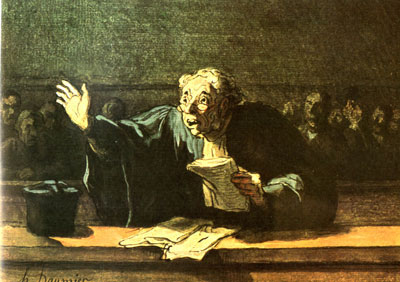

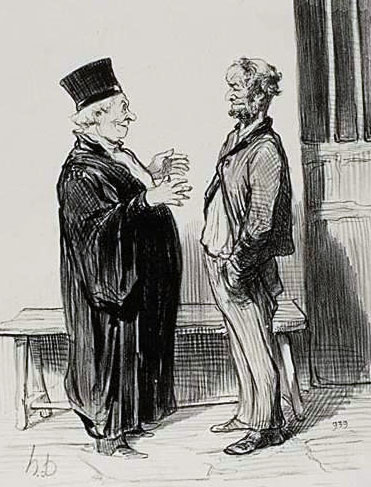
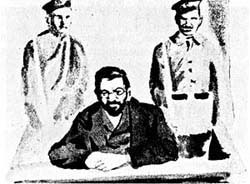 In Russia (and, later, in the USSR, and, again, Russia), artists were first admitted into courtrooms in the mid-19th century. In 1881, at the “March 1” Group (the “Pervomartovtsi”, or the “People’s Will” underground anti-Tsarist organization members) Trial there were present at least three artists: explorer and medical doctor Pavel Pyasetsky, “Itinerant” painter Vladimir Makovsky, and police artist A. Nasvetevich. There still exist sketches from the Beilis Trial in 1913.
The famous painting by the Soviet group Kukryniksy “The End. The Last Hours in Hitler’s Hideaway” and their graphic series “Accusation” (portraying war criminals and their lawyers at the Nuremberg Trial in 1945-1946) were based on the artists’ eyewitness accounts of the Nazi criminals court trial. The Nuremberg Trial participants were also depicted by Soviet cartoonist Boris Yefimov in his “Nuremberg Series”.
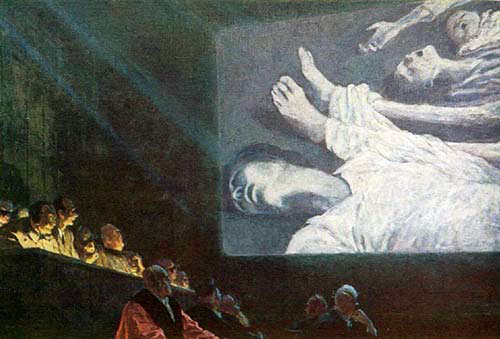
In the United States there are dozens of eminent artists famous for their court drawing.
American illustrator Leo Hershfield (1904-1979) worked in courtrooms at the trials of the Chicago Seven charged with conspiracy and inciting to riot; the Harrisburg Seven and the Gainesville Eight, who protested against the war in Vietnam; he drew the proceedings at major trials of pediatrician and civil rights advocate Benjamin Spock; American war criminal William Calley, sentenced to life imprisonment at hard labor for ordering the My Lai Massacre; Clay Shaw, the only person prosecuted in connection with the assassination of President John F. Kennedy; Jack Ruby who shot Lee Harvey Oswald; Arthur Bremer, convicted for an assassination attempt on presidential candidate George Wallace; the murderer of Martin Luther King Jr. James Earl Ray, etc.
Famous comic book artist Dick Rockwell (1920-2006) participated in court trials of Weather Underground and Black Liberation Army radical organizations.
Journalist and artist Rosalie Ritz (1923-2008) covered proceedings at the trials of Patty Hearst who had joined the leftist radical organization “Symbionese Liberation Army”; Sirhan Sirhan, the senator Robert F. Kennedy killer; Charles Manson, the leader of apocalyptic quasi-commune responsible for the murder of actress Sharon Tate; and the Black Panthers (Huey P. Newton, Angela Davis) trials. American illustrator Bill Lignante worked alongside with her in covering Charlie Manson, Patty Hearst, and Sirhan Sirhan.
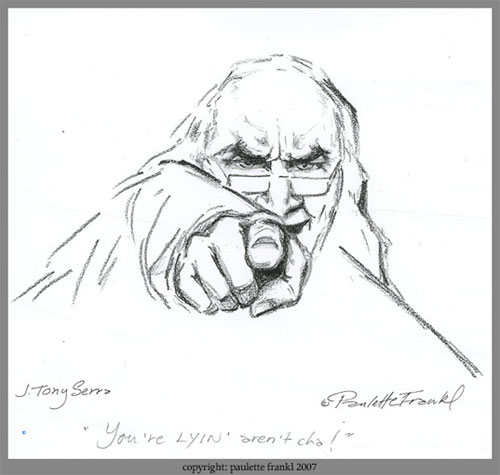
Paulette Frankl still works as a courtroom artist. She covered major trials of American civil rights attorney J. Tony Serra, Ellie Nesler who killed her young son’s molester in 1993, and the gambling executive Ted Binion’s murder trial in the late 1990’s, among others.
In 2005, there was an art show “Case Studies” by Moscow artist Pavel Shevelev, exhibiting his sketches from Meshchansky Court where the case of Mikhail Khodorkovsky and Platon Lebedev was heard in 2004-2005. In his interview to “Novaya Gazeta” the artist said about the most interesting part of this job, “The most interesting part is that there are 50 thousand artists in Moscow, but it occurred to no one just to come and draw this trial. And there are 5 million people who don’t come to the court”.
Contemporary Court Artists:
Courtroom Art — courtroomartonline.com
Rosalie Ritz — www.my-ecoach.com/rosalieritz
Paulette Frankl — pauletteart.com
Dana Verkouteren — danaverkouteren.com
Janet Hamlin — janethamlin.com
Marilyn Church — marilynchurch.com
Patrick Flynn — 3flynns.com
Steve Werblun — stevewerblun.com
Mona Shafer Edwards — monaedwards.com
Art Lien — courtartist.com
Organizers
Since 2004, the Sergey Kuznetsov Content Group (www.skcg.ru) has been providing content for and supporting Internet sites, including not-for-profit efforts, as well as promoting them in social media. The company’s projects have received a number of professional awards, and reached top positions in Internet sites popularity ratings. The company has been working in close cooperation with numerous non-profit organizations, including the AVI CHAI Foundation, British Council, Transatlantic Partners against AIDS, Russian Media Partnership against AIDS, etc.
 The Andrey Sakharov Memorial Museum and Community Center for Peace, Progress and Human Rights (www.sakharov-museum.ru) was established by the international nongovernmental organization, The Andrey Sakharov Foundation: The Public Commission for the Preservation of the Legacy of Academician A.D. Sakharov, in 1996. The Museum and Community Center promote the preservation of historic memory of millions of political repression and Soviet regime crimes victims, as well as the consolidation of open democratic society and government values in contemporary Russia. The Museum’s permanent exhibition features the thematic shows “The USSR Mythology and Ideology”, “The Political Repression in the USSR”, “The Road through the GULAG”, “The Resistance to the Unfreedom in the USSR”, and “Andrey Sakharov, His Personality and Destiny”. The Museum arranges temporal exhibitions on a regular basis, together with roundtable discussions, seminars, and public debates. Being a complex cultural and social/human rights organization, it also carries out research programs and projects.
Partners
 The project’s title partner is the OpenSpace.ru portal (www.openspace.ru).
The OpenSpace.ru Internet portal was launched in 2008 by the ArtMedia Group. Today, this is the only general-interest thematic resource in the Russian Internet that speaks about topical events in cinema, music, theater, literature, arts, and media in an accessible language, also covering Russian and global society issues. According to the Gallup Media estimates, the OpenSpace.ru’s monthly audience amounts to over 900 thousand unique users. The OpenSpace.ru contributors are the eminent experts and best specialists in their fields. This is the reason why their opinions expressed through the portal, resonates widely and deeply in the Russian society, and visibly changes the living reality’s landscape around us.

Creative People Network Kroogi.com, a unique multilingual online platform for the presentation and development of various artistic cultures. Kroogi is an ethical model for distributing copyrighted material with a "Pay What You Want" commercial principle.
Culture News Agency Gif.ru.
Khodorkovsky & Lebedev Communications Center (khodorkovskycenter.com).
